





 Subscribe


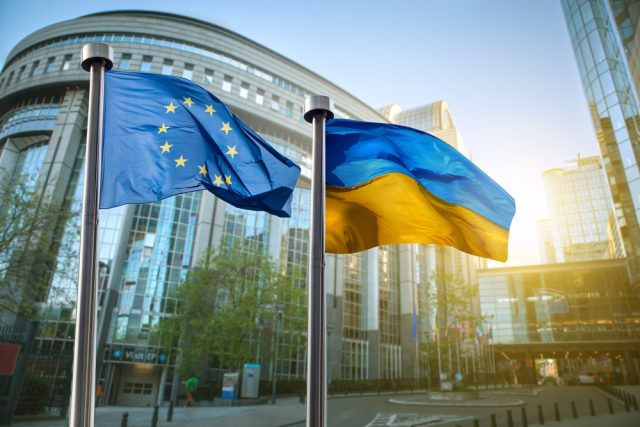
Four years into Russia’s full-scale invasion of Ukraine, Europe finds itself in an uncomfortable but necessary moment of introspection. The initial clarity of 2022 — moral outrage, strategic alignment, rapid mobilisation — has given way to a more complex landscape in which solidarity, sovereignty, security, and institutional prudence collide.
On the one hand, many political families across the continent remain firm: Ukraine must be supported, or at the very least, Ukraine cannot fall. And thus, Russian aggression cannot be accepted and even less rewarded. The sovereignty of a European nation cannot be negotiated away under coercion. That baseline remains intact.
And yet, beyond that clarity, doubts begin to emerge — not about support itself, but about the direction in which the European Union is moving.
The debate over Ukraine’s accession to the EU encapsulates this tension. Accession is increasingly framed as a natural and morally necessary extension of solidarity. If Ukraine is fighting for Europe, the argument goes, then Europe must bind Ukraine irreversibly into its institutional core. In a surprising turn of events, it seems that Ukraine is fighting on Europe’s behalf rather than asking Europe to fight in Ukraine’s instead. That’s been Zelenski’s rhetoric over the last few years, and that’s what he articulated in his address to the European Parliament on 24 February 2026. In this speech, Zelenski urged EU leaders to provide Ukraine with “a clear date for accession” to the Union. Framing enlargement as part of the diplomatic architecture necessary to end the war
But accession is not a symbol. It is a structural transformation of the Union. It would alter budgetary balances for decades. It would reshape cohesion policy and agricultural funding. It would recalibrate voting weights and political dynamics within the Council. Most importantly, it would implicitly entangle the EU’s institutional future with an unresolved territorial conflict.
The European Union has enlarged many times in its history. It has never enlarged into a live war. Supporting Ukraine in its defence is one matter. Integrating a country at war into the Union’s constitutional architecture is another entirely. The two are not interchangeable despite Zelenski’s well-crafted rhetoric.
If anything, the fact that the war has now entered its fourth year should compel Europe not only to sustain assistance — the scale and composition of which remain politically contested, even as figures such as the proposed €90 billion package suggest a commitment covering roughly two-thirds of Ukraine’s projected funding needs — but to think far more seriously about its long-term strategic direction.
A conflict of this duration, entrenched on European soil, cannot be treated as a temporary emergency. It is reshaping the continent’s security psychology. Yet it is doing so unevenly.
For Poland, the Baltic States, and Romania, the war is not a distant geopolitical drama. It is a nearby and tangible threat. Military logistics move across their territories. Refugee flows are immediate. Escalation scenarios are debated not in academic seminars but in defence ministries. Citizens in these frontline Member States do not experience the conflict abstractly; they experience it as proximity. The sense of vulnerability is real, and it informs their insistence on firmness, speed, and strategic clarity.
In contrast, for countries such as Italy, Spain, Portugal, or Ireland, the war — while morally significant and politically consequential — remains geographically and psychologically more distant. Threat perceptions are filtered through energy prices, budgetary pressures, and domestic political debates rather than through direct border anxieties. Public opinion in these states often reflects a different calibration between solidarity and risk, between endurance and negotiation.
This divergence may very well lead to disunity, as we see with the Hungarian position. And it also reveals that European cohesion rests on differing strategic intuitions. What feels existential in Warsaw may feel contingent in Lisbon. What appears urgent in Tallinn may seem negotiable in Madrid.
It is precisely because of this internal asymmetry that the European Union cannot confine itself to financing resistance alone. If the aim is to truly sustain Ukraine, beyond (or perhaps away from) military aid, the EU should concern itself with a leading role in shaping the diplomatic architecture of a credible peaceful resolution. A war that unfolds on European soil cannot have its political settlement designed elsewhere.
The United States remains indispensable. NATO remains central to deterrence. Yet the EU cannot indefinitely outsource the strategic endgame of a war that is redefining its own security environment. Bridging the divide between frontline urgency and peripheral distance requires not only money, but leadership — leadership capable of aligning divergent threat perceptions into a coherent continental strategy. If the conflict is European in geography and consequence, its eventual resolution must also be European in design.
There is a paradox at the heart of the current debate. The Union was conceived as a peace project, grounded in economic interdependence and institutional integration as an antidote to war. Yet today it is evolving into a geopolitical actor that finances military resilience on an unprecedented scale. Since 2022, hundreds of billions of euros have been mobilised in various forms of support.
This transformation may be necessary. But it has not been sufficiently digested politically. Not at the supply side of politics and even less so on the demand side. Are European citizens fully aware that the Union is undergoing such a profound redefinition? Are they prepared for a European project increasingly intertwined with long-term security commitments and defence coordination? These questions are not expressions of hostility toward Ukraine. They are expressions of democratic responsibility.
Across Europe, voices urging caution on accession are sometimes portrayed as hesitant or insufficiently committed. That framing is misguided. One can firmly oppose Russian expansionism and simultaneously question whether wartime enlargement is prudent. Sovereignty is not a rejection of solidarity; it is the condition that allows solidarity to endure.
Governments that cannot clearly articulate the limits of their commitments risk eroding the domestic legitimacy upon which those commitments ultimately depend. Political capital is not infinite. Public consent cannot be assumed indefinitely in a prolonged war environment marked by inflation, energy pressures, demographic strain, and social fatigue.
The institutional questions surrounding accession remain unresolved. Would membership apply only to territories currently under Kiev’s control? Would the Union implicitly commit itself to the recovery of all internationally recognised Ukrainian territory? How would reconstruction costs and integration into cohesion and agricultural frameworks be financed without triggering distributive tensions among Member States? These are not procedural technicalities. They are foundational decisions that would shape the Union for generations.
History offers sobering lessons about political entities whose external ambitions outpace their internal cohesion. Overreach often begins with moral conviction and geopolitical urgency. It rarely announces itself as excess. Yet institutions endure only when ambition remains aligned with capacity.
Four years into the war, Europe stands at a delicate crossroads. The question is not whether to support Ukraine. That remains clear. The question is whether, in doing so, the European Union risks redefining itself in ways that have not been sufficiently debated or democratically anchored.
There is no contradiction between sustaining Ukraine and insisting on prudence regarding accession. Indeed, preserving the Union’s long-term coherence may be the best guarantee that European solidarity remains credible and sustainable.
If Europe wishes to demonstrate unity, it must ensure that unity rests not only on moral impulse but on strategic clarity, international realism, and a serious commitment to shaping a durable peace.
For the truth is that war tests Ukraine’s endurance and also tests Europe’s capacity to combine conviction with restraint. And that balance may ultimately determine the future of the European project itself.