





 Subscribe


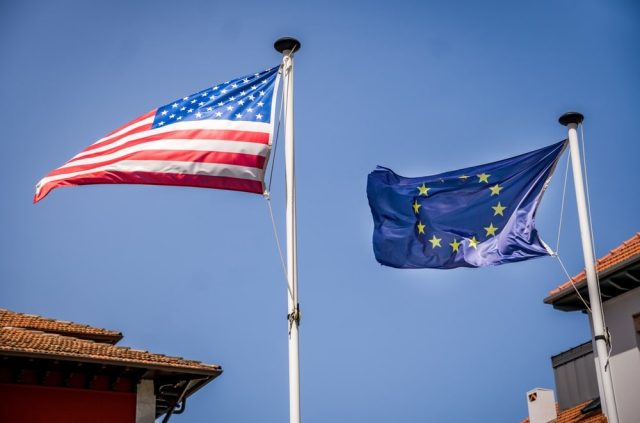
Andrius Kubilius argues that shifting U.S. strategy, technological dependence, and fragmented industries force the European Union to take full responsibility for its own security.
The European Union can no longer assume that the United States will remain the unquestioned backbone of its security. That is the stark warning delivered by Andrius Kubilius, the EU Commissioner for Defence and Space, in an interview with the Italian investigative program Report. A lifelong Atlanticist and former prime minister of Lithuania, Kubilius now finds himself confronting a reality he once struggled to imagine: Washington is redefining its priorities, and Europe must prepare to stand on its own.
Kubilius points to the latest U.S. National Security Strategy, shaped by thinkers such as Elbridge Colby, now a senior Pentagon official. The underlying message is clear: the United States no longer believes it can or should police the entire globe. Instead, it aims to prevent any single power from becoming dominant in a given region, with a primary focus on countering China in Asia. In this framework, a stronger and more autonomous European Union is no longer seen as an unambiguous asset, but potentially as a rival regional power.
“I don’t agree with this approach,” Kubilius says, stressing that European unity remains vital even for American interests. Yet he acknowledges that transatlantic relations are already changing. “We must accept this rationally and start preparing immediately,” he argues. For him, that means assuming direct responsibility for Europe’s defence rather than relying indefinitely on U.S. guarantees.
The central question, then, is who will lead European defence in a world where American support may diminish. Kubilius describes the current moment as a transition phase. Over the past year, his work has focused on “material defence”: ramping up weapons production and procurement. But institutional limits are now coming into focus. The so-called “European pillar of NATO” remains poorly defined, even though NATO itself continues to be indispensable. Collective defence, Kubilius insists, is non-negotiable, since no single European country—however large—can match Russia’s military power alone.
At the same time, he raises the possibility of new leadership structures. One idea under discussion is a European Security Council, bringing together key countries such as Germany, France, Italy, the United Kingdom, and Poland, alongside rotating member states and EU leadership. Such a body could provide political direction during major security crises, especially if U.S. engagement weakens further.
A major obstacle to European autonomy, however, lies in technological dependence. Kubilius openly criticizes Europe’s reliance on U.S.-made weapons systems. While acknowledging their quality, he warns of the risks embedded in American export controls, particularly the International Traffic in Arms Regulations (ITAR). Under these rules, Washington retains the power to limit how and where U.S.-origin weapons can be used—even after they are sold.
He cites the example of Ukraine: French-made long-range missiles were cleared for strikes on Russian territory, while British missiles containing U.S. components were not, because Washington denied permission. “If a government buys weapons, it must be certain its army can use them when and where necessary,” Kubilius argues. “Without having to ask someone else for permission.” For him, this is proof that Europe must build genuine strategic autonomy in defence.
Yet achieving that goal will take time. Most defence spending still comes from national budgets, while the EU’s own defence resources are tiny by comparison—roughly one hundredth of what member states spend collectively. This creates a vicious circle: countries buy non-European weapons because European industry lacks capacity, and European industry remains weak because countries do not invest in it. Breaking this cycle is one of Kubilius’s main priorities.
Fragmentation is another challenge. Competing initiatives such as Germany’s European Sky Shield Initiative and Italy’s proposed “Michelangelo Dome,” promoted by Leonardo CEO Roberto Cingolani, illustrate how national interests often prevail over coordination. Kubilius says he has already spoken with Cingolani and plans a post–New Year roundtable between Italian and German stakeholders to explore a common path forward. “We need a European air defence very soon,” he stresses.
Finally, Kubilius addresses a politically sensitive issue: the cost of defence. Increased military spending, he admits, will require difficult budgetary choices. But he frames the alternative in stark terms. If Europe fails to deter Russia—allowing it to prevail in Ukraine and potentially threaten EU member states—the social model Europeans cherish will collapse anyway. “That,” he concludes, “is what would truly destroy our way of life.”
In Kubilius’s view, Europe’s moment of strategic truth has arrived. The question is no longer whether the EU wants to defend itself, but whether it can afford not to.
Alessandro Fiorentino