





 Subscribe


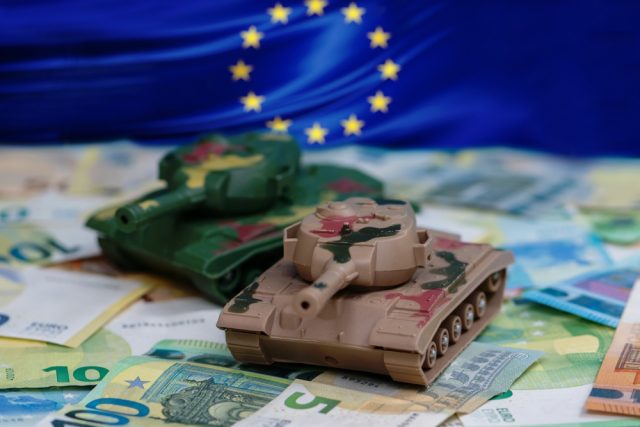
For decades, European politics has been convinced that its strength lies in rules—regulations on human rights, the market, climate, and various other areas. In short, a regulatory giant. But history—real history—has returned with a vengeance. Wars, instability, asymmetric threats, military rivalries. It is in this context that the imperative emerges: sovereignty is not written in regulations or declarations of intent. It is manufactured. In steel mills. In shipyards. In missile centers. On assembly lines.
For the first time, the European Union—with its recent green light for the industrial defense program—seems to have finally understood this.
The move: first Brussels, then the factories
On November 25, 2025, the European Parliament finally approved the EDIP: a €1.5 billion package for the three-year period 2025-2027, designed to strengthen the European defense industrial and technological base (EDTIB), ensure readiness to respond to threats, coordinate purchases and production, and also include Ukrainian industry through a dedicated support instrument.
This is not a ‘slogan fund’: it is the first real structural framework that the EU has dedicated to industrial defense — no longer an emergency, but a long-term project.
It is as if we had spent years discussing how to make the perfect pizza, and only now have we decided to buy ovens, dough mixers, and real ingredients: no more theory, but concrete work.
Behind the ratification: real tensions, political disagreements, different visions
The fact that this was not a unanimous consensus is demonstrated by the position of the ECR group — the European political family to which forces such as ours belong: ECR MEPs voted against the first version of the text — the one used in the Industry and Defense committees — because they considered it “form without function,” lacking in some decisive chapters.
Why did they vote that way? Because in sovereignist and conservative circles, there has long been a feeling that Europe does not need empty proclamations, but infrastructure, production capacity, real supplies, robust supply chains, and — above all — rapid pragmatism. A program that is lame, uncertain, or overly bureaucratic risks coming to nothing. Better to have a concrete, clear, and incisive plan.
In the end, the EDIP was passed, but only after the Parliament and the Council — probably under pressure from geopolitical realities — reached a compromise that at least formally contains:
- limits on the use of non-EU components (maximum 35%), to realistically preserve the “Buy European” principle.
- the integration, from the outset, of Ukrainian industry into the European scheme, as a ‘de facto partner’ in European defense.
- a system that is not just a ‘one-off’, but designed as a permanent structure, capable of providing an industrial backbone for Europe’s defense for the next decade.
It is a victory — but a fragile one, hanging in the balance: it depends on how it is implemented. And, above all, on whether national and EU policy maintains consistency between projects and real support.
Because for the conservative right, it is a turning point — if it is not betrayed
Those who write from conservative positions know that sovereignty is not an abstract concept: it is concrete, material. It is the ability to defend family, people, nation. To defend borders, cities, civilization. And so…
- The defense industry is not a relic of the past, but the wooden slat on which freedom rests.
- “Buy European” is not obtuse protectionism, but strategic awareness: we cannot rely on fragile global chains when war is knocking at the door.
- Openness to integration with Ukrainian industry is not do-goodism: it is geopolitical realism: it strengthens Europe as a bloc.
- The “defense as a market” model must be abandoned: we need “defense as a national/European capability.”
If EDIP is truly implemented, in line with this vision, it could be the beginning of an industrial and defensive renaissance for the Old Continent.
But the risks are real. And the right must be vigilant.
Because it is not enough to approve a program.
- If bureaucratic procedures, tenders, certifications, and regulatory abstractions slow it down, it will end up like many European “big ideas”: in long years of nothing.
- If large groups monopolize the funds and SMEs are left out, the original spirit will be betrayed: that of a widespread, pluralistic, resilient industrial base.
- If the ‘Buy European’ principle is circumvented or misinterpreted, we will return to the risk of dependence on foreign components — precisely the weakness we wanted to avoid.
- If ‘Ukrainian integration’ becomes a way of offloading heavy production onto Kiev, without a common strategic plan, everything risks coming to nothing.
For this reason, the conservative right has a dual responsibility: not only to applaud when these measures are approved, but also to ensure that they are implemented in practice — with rigor, vision, and consistency.
A turning point — if we are up to the task
The EDIP could truly mark a turning point for Europe. Its significance will not be measured in press releases or ritual rhetoric, but in its ability to transform limited resources into a vibrant industry: factories that work, supply chains that regain momentum, ammunition that rolls off the production line, shipyards that never stop. That is where European credibility will be born.
Those who see Europe as a civilization—and not as a collection of directives—recognize that strength cannot be improvised: it must be built. It depends on a political will capable of holding together the identity, responsibility, and free will of peoples. It requires clarity, determination, and the certainty of not wanting to delegate one’s security to anyone else, neither Moscow nor Beijing, neither Ankara nor any other capital.
It is clear that something has changed. But the proof will not be a vote in Parliament. It will be the speed with which we return to production. It will be the determination with which we attract investment, reorganize value chains, support Ukraine, and consolidate the industry we have on our territory. It will be the ability to refocus on the idea that Europe exists when it is able to defend itself.
And this is where political responsibility begins. There is no need for triumphalism, but rather for decisions. We need to be vigilant, persistent, and demand consistency. Because a program can pave the way, but only a conscious ruling class can transform it into the backbone of European security.