





 Subscribe


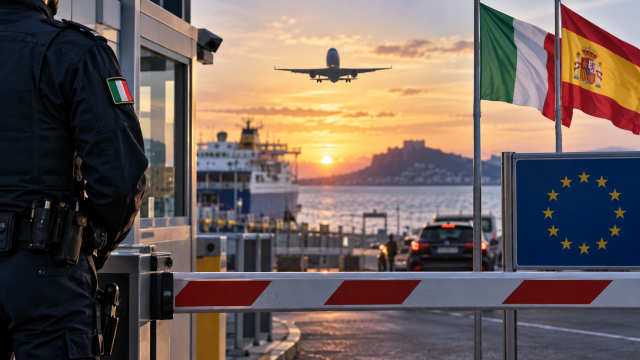
Rome cites persistent risks of terrorist infiltration and secondary migration movements as temporary checks at air and sea borders remain in place under Schengen rules
Italy has extended temporary border controls with Spain for another 15 days, maintaining checks on air and maritime connections between the two countries amid continuing concerns over internal security and the possible infiltration of terrorists through irregular migration routes.
Interior Minister Matteo Piantedosi announced the extension on September 15 after an assessment by Italy’s Committee for Immigration and Border Security Analysis. Rome formally communicated the decision to the European Commission and the interior ministers of the other European Union member states.
According to the Interior Ministry, the security conditions that prompted the introduction of the controls have not yet disappeared. Authorities continue to identify “high risk profiles” for domestic security, alongside concerns that irregular migratory movements could potentially be exploited by individuals linked to terrorist organisations.
The measure represents a temporary reintroduction of internal border controls rather than, strictly speaking, a suspension of Italy’s membership of the Schengen area. Under the Schengen Borders Code, participating states normally allow people to cross their internal borders without systematic checks. However, EU legislation permits governments to temporarily restore controls when a serious threat to public policy or internal security has been identified.
Such action must remain exceptional. European rules specify that internal border controls should be used as a last resort and must satisfy tests of necessity and proportionality. Their geographical scope and duration should also be limited to what is strictly required to address the identified threat.
The Italian-Spanish measures originated in the migration emergency that developed around Ceuta, the Spanish autonomous city on the North African coast bordering Morocco. Italy initially introduced controls from August 1 following a sharp increase in irregular entries into the Spanish enclave and concerns that some migrants could subsequently move through the Schengen area towards other European countries.
Rome then extended the controls at the end of August. At that stage, the Interior Ministry acknowledged measures being taken by Spain and the European Union to stabilise the situation, while concluding that the circumstances justifying additional precautions had not yet sufficiently subsided.
The latest extension demonstrates that Italian security authorities remain cautious. The concern involves not merely the number of irregular arrivals, but what European authorities describe as “secondary movements”: migrants entering the Schengen area through one country before travelling without authorisation towards another member state.
Terrorism adds a separate and more sensitive security dimension. The revised Schengen Borders Code explicitly identifies terrorist incidents or threats among the circumstances that can constitute a serious threat to internal security. However, the existence of such a legal basis does not mean that irregular migration itself is equated with terrorism. Rather, authorities are assessing the possibility that uncontrolled movements could create vulnerabilities capable of being exploited by dangerous individuals.
The dispute also illustrates a broader challenge facing Schengen. Europe’s border-free area is one of the EU’s most tangible achievements, allowing hundreds of millions of residents to travel between participating countries without routine internal border checks. Yet governments have increasingly resorted to temporary controls in response to terrorism, irregular migration, organised crime and geopolitical instability.
Italy itself currently maintains separate controls on its land border with Slovenia, citing risks including terrorist infiltration along the Western Balkan route, irregular migration and criminal smuggling networks. Other Schengen countries have introduced controls at various internal borders for their own security and migration-related reasons.
Spain, meanwhile, has also notified temporary controls affecting its internal air and sea borders with Italy, highlighting the bilateral implications of the current security situation.
The key question is therefore how long the exceptional arrangements will remain necessary. Under EU law, repeated extensions require governments to continue demonstrating that the threat persists and that border controls remain proportionate to it. Alternative measures, including intensified police cooperation and targeted law-enforcement checks, must also be considered.
For now, Piantedosi’s decision signals that Rome believes the conditions for returning fully to normal Schengen procedures with Spain have not yet been met. The additional 15-day period will give Italian authorities another window in which to monitor developments in Spain, migration movements across Europe and intelligence assessments concerning possible security threats.
Alessandro Fiorentino