





 Subscribe


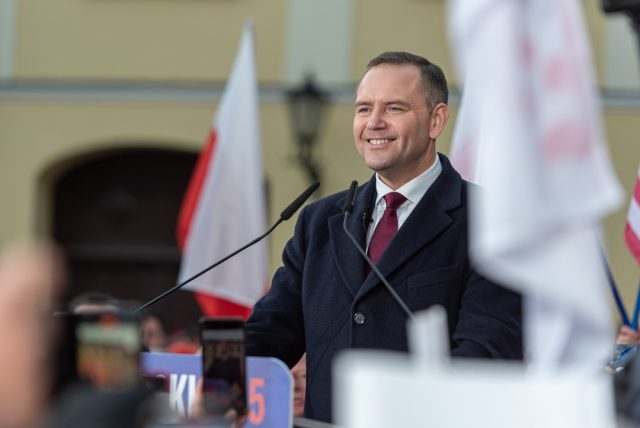
Polish President Karol Nawrocki has already made it a practice to exercise his veto whenever a bill presented by his country’s parliament is at odds with his national-conservative vision. When his opposition through veto aroused the interest of European public opinion, the establishment’s reaction was the same: this veto paves the way for a new dispute between the “nationalist and Eurosceptic” president vs. the “centrist and pro-European” prime minister. The same adjectives and the same description every time. The same rethoric. In short, it is the Eurosceptic Nawrocki who is trying to “thwart” the legislative agenda of the pro-European Tusk.
Of course, such an interpretation does not surprise anyone – or should not surprise anyone. Even if the nuances differ depending on the person or the situation, the narrative is always the same. But Nawrocki is not a Eurosceptic, and Prime Minister Tusk is by no means more pro-European than the President of Poland.
When Karol Nawrocki uses his veto to block a law that would harm his country, he is acting to protect Poland’s interests. He is pro-Poland, but no less pro-European. This is a fundamental argument, but one that is not accepted by the other side of society.
Less than three weeks after his powerful speech at the inauguration, the new president vetoed the extension of aid for Ukrainian refugees in Poland. Karol Nawrocki was thus expressing his strong disagreement with the difference in treatment between Poles and Ukrainian guests, stating that “Polish citizens are treated worse in their own country.” His gesture was fully consistent with his statements during campaign and in line with the opinion of the majority of Polish society, which did not approve of the excessive amount of social assistance granted to Ukrainians.
When, in mid-November, he announced that he was using his veto to block the appointment of 46 new judges close to the Tusk government, the establishment used the same rethoric: “a new episode in the war between the president and the prime minister,” “a new political crisis”, and so on. In fact, Nawrocki used this presidential prerogative to stop the appointment of magistrates whom he accused of undermining Poland’s constitutional order—a very troubling accusation.
Few days ago, another veto by the president caused waves far beyond the Poland’ borders. This time, Karol Nawrocki blocked the law implementing the Digital Services Act, the European legislation that regulates the so-called moderation of online content. In his statement explaining why he opposed the law already approved by Parliament, Nawrocki referred to the infamous Ministry of Truth in Orwell’s dystopian novel 1984, a reference that no longer seems like a metaphor or an exaggeration. How can a government official be empowered to determine what should and should not remain published online? Who can decide what is “truth” and what is “misinformation” or “hate speech” in the digital environment, and how? To what extent can freedom of expression, a core principle, truly be defended if a certain part of society is denied the right to express its opinion? Protecting children from dangerous content distributed online should not be incompatible with protecting freedom of expression, argues Karol Nawrocki.
When the Polish president calls for a revised version of the law, he is in fact calling for a new draft law that does not conflict with the interests of the Polish nation or with fundamental rights and freedoms. No matter how strongly and insistently the establishment argues that each veto means a new political crisis, the reality only shows how fragile this propagandistic framework is. Karol Nawrocki’s strategy is not to block everything that comes from the government or the current parliamentary majority in order to flex his muscles in front of his political opponents, but to fullfil his commitments to the Polish people and fight for his country’s interests. Even if this means greatly irritating the globalist establishment or facing criticism for maintaining a conflict with the so-called pro-European government.