





 Subscribe


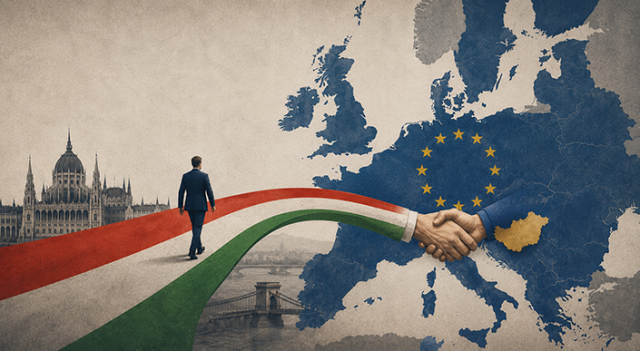
The arrival of Péter Magyar opens a new chapter for Brussels, offering the European Union a chance to regain momentum on Ukraine, the Western Balkans and democratic cohesion
For more than a decade, discussions surrounding European Union enlargement were often overshadowed by one recurring obstacle: Hungary’s increasingly confrontational stance toward Brussels under the leadership of Viktor Orbán. From sanctions policy to Ukraine and the Western Balkans, Budapest frequently positioned itself as the Union’s most difficult negotiating partner, slowing collective decisions and exposing the limits of unanimity within the EU system.
Now, with Orbán’s long political era apparently coming to an end and the new government led by Péter Magyar beginning to reshape Hungary’s role inside Europe, Brussels is cautiously exploring what this transition could mean for the future of the Union itself.
The significance of the political change in Budapest goes far beyond domestic Hungarian politics. For the EU, it represents a potential strategic turning point at a moment when enlargement has once again become one of the bloc’s central geopolitical priorities.
Over the last three years, the European Union has increasingly treated enlargement not only as a bureaucratic accession process, but as a broader security and stability project. Russia’s invasion of Ukraine fundamentally transformed the way many European leaders perceive the Union’s borders and its neighborhood. Countries once considered politically distant from membership — particularly Ukraine and Moldova — suddenly became central to the EU’s long-term strategic vision.
In this context, Hungary’s previous obstructionism created growing frustration among European institutions and member states alike. Orbán’s government repeatedly delayed decisions tied to financial support for Kyiv, sanctions packages and accession negotiations, often arguing that Brussels was moving too quickly or acting against Hungarian national interests.
The arrival of Magyar does not necessarily signal a dramatic ideological revolution in Hungarian foreign policy. Hungary is unlikely to abandon its emphasis on sovereignty or become unconditionally aligned with every initiative emerging from Brussels. However, early signals suggest a far less confrontational approach, one based more on negotiation than systematic vetoes.
That difference alone could substantially improve the European Union’s ability to act cohesively.
Ukraine will likely be the first major test of this new relationship. European officials are hoping that Budapest will stop functioning as a permanent brake on Kyiv’s accession process, allowing negotiations to advance with greater political stability. While important issues remain unresolved — including minority rights and bilateral tensions between Hungary and Ukraine — the atmosphere surrounding discussions in Brussels has already shifted noticeably.
For EU institutions, this matters enormously. Enlargement toward Ukraine is no longer viewed merely as a symbolic political gesture. It has become tied to Europe’s broader ambition to demonstrate resilience, unity and geopolitical credibility in the face of Russian aggression.
The implications extend beyond Eastern Europe. Orbán spent years cultivating close relationships with nationalist and illiberal actors across the Western Balkans, often supporting leaders accused by Brussels of democratic backsliding. Serbia’s Aleksandar Vučić and Bosnian Serb leader Milorad Dodik, in particular, benefited from having a powerful ally within the European Council capable of softening criticism and slowing pressure from EU institutions.
A less ideologically driven Hungarian government could alter this balance. Brussels may find greater freedom to promote democratic reforms and rule-of-law standards in the Balkans without facing constant resistance from Budapest. This does not mean the region’s problems will disappear overnight, but it could gradually strengthen the EU’s leverage in accession negotiations.
Georgia also illustrates the broader consequences of Hungary’s transformation. Under Orbán, Hungary frequently defended the Georgian leadership despite growing European concerns over democratic regression and authoritarian tendencies. With Budapest potentially recalibrating its position, pro-European forces inside Georgia may feel newly encouraged, while the ruling establishment could lose one of its most reliable supporters within the Union.
Yet the Hungarian transition also exposes a deeper institutional debate that Europe can no longer avoid: the question of unanimity.
For years, EU foreign policy has repeatedly been slowed by the ability of single member states to veto collective decisions. Hungary became the most visible example of this problem, but many European diplomats privately acknowledge that other governments often hid behind Budapest’s opposition to avoid openly taking controversial positions themselves.
This is why the current moment is generating renewed discussion about qualified majority voting, particularly in foreign policy and enlargement matters. Supporters argue that a Union preparing for future enlargement cannot remain structurally vulnerable to internal paralysis. Critics, however, fear that abandoning veto powers could weaken national sovereignty and create tensions between larger and smaller member states.
Even with Orbán no longer dominating Hungarian politics, these divisions will not disappear. Countries such as France, the Netherlands and Greece still maintain significant reservations regarding rapid enlargement, especially when questions of migration, institutional reform and economic integration are involved.
Nevertheless, the political shift in Budapest changes the atmosphere inside Europe.
For the first time in years, the European Union can realistically imagine a future in which enlargement debates are driven less by permanent internal confrontation and more by strategic calculation. Whether this opportunity ultimately produces lasting reform will depend not only on Hungary’s new leadership, but also on the willingness of the EU itself to adapt to a rapidly changing geopolitical landscape.
Alessandro Fiorentino