





 Subscribe


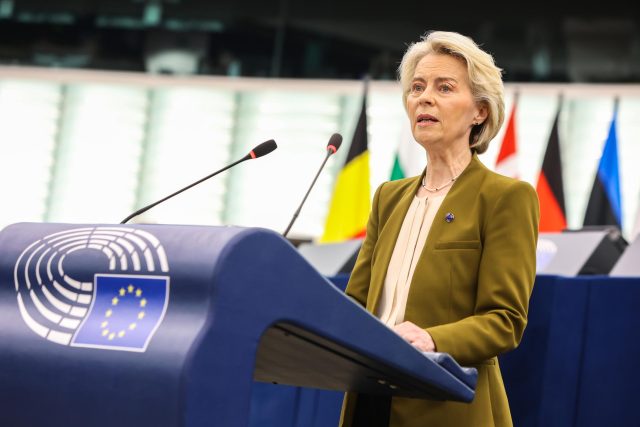
Commission President urges leaders to choose between Russian assets or common debt, while Socialists and Liberals accuse her of appeasing Trump
On the eve of a crucial European Council meeting in Brussels, European Commission President Ursula von der Leyen delivered a combative speech to the European Parliament in Strasbourg, calling on the EU to defend itself in a world of “wars and predators” and to urgently unlock new funds for Ukraine. Her intervention came nearly two weeks after the publication of the controversial US National Security Strategy, widely seen in Europe as signaling a downgrading of transatlantic commitments, especially toward the continent’s security.
Without ever mentioning Donald Trump by name, von der Leyen responded directly to the narrative emerging from Washington. “We should not be shocked by what others say about Europe,” she told MEPs, adding that claims about the EU have often proved wrong in the past. She acknowledged that the US strategy was correct in noting Europe’s declining share of global GDP—from 25% in 1990 to 14% today—but pointedly reminded the chamber that the United States has followed the same trajectory, falling from 22% to 14% over the same period. The real shift, she argued, has been China’s dramatic rise, from 4% to 20% of global GDP.
Von der Leyen framed this reality not as a transatlantic reproach, but as evidence of a profound transformation in global economic and political balances. Yet her decision to gloss over the harsher accusations contained in the US strategy—claims that EU institutions undermine freedom and sovereignty, stifle growth through bureaucracy, and promote censorship through digital regulation—sparked an immediate backlash from the Parliament’s center-left and liberal groups.
Accusations of appeasement
Iratxe García Pérez, leader of the Socialists and Democrats, openly rebuked the Commission president. “You have not said a word about the threats coming from the United States,” she said angrily. “Enough with appeasement and flattery toward autocrats. It will not bring peace, only more conflict.” The liberal Renew group echoed the criticism in more measured tones. Its leader, Valérie Hayer, close to French President Emmanuel Macron, warned that appeasement does not work and called for resisting any form of “vassalization,” while preserving the transatlantic relationship.
Von der Leyen, however, chose to steer the debate away from direct confrontation with Washington and toward what she described as the broader geopolitical lesson of the moment. The combined effect of Russia’s aggression and America’s increasingly transactional stance, she argued, has created a far more dangerous world in which Europe can rely only on itself.
Europe in a world of “wars and predators”
“At tomorrow’s European Council we must affirm that we take care of our own strategy, our own interests and our own priorities,” von der Leyen declared. “This is Europe’s moment of independence.” The applause in the chamber was polite rather than enthusiastic, reflecting lingering doubts about how realistic such ambitions are.
To bolster her case, the Commission president pointed to recent achievements once thought impossible. She recalled the EU’s decision to end dependence on Russian gas and oil, years of hesitation finally swept aside by the war in Ukraine. She also highlighted a dramatic shift in defense policy, with new industrial capacities being built to address hybrid warfare and military threats. “We have done more for defense in one year than in an entire decade,” she said, noting that €800 billion in investments have been launched this year alone. The EU’s SAFE program—providing favorable loans for defense investments—has been oversubscribed, with 19 countries already requesting funds and others asking for more.
The Ukraine funding dilemma
Yet when it comes to Ukraine, fresh resources are precisely what Europe lacks. With US military aid effectively frozen, Kyiv faces a critical funding gap over the next two years. How to fill it is the central dilemma confronting EU leaders in Brussels.
Von der Leyen reiterated the EU’s commitment to cover two-thirds of Ukraine’s financing needs in 2026–2027, amounting to €90 billion. To achieve this, she has put forward two options: using frozen Russian assets or issuing new common European debt. Both paths remain politically fraught. Belgium, Hungary, the European Central Bank and Italy have raised objections to confiscating Russian assets, while the so-called “frugal” countries, led by Germany, remain deeply opposed to new joint borrowing.
Still, von der Leyen urged leaders to decide now. She recalled that the EU has already taken a significant step by immobilizing indefinitely more than €200 billion in Russian assets held in European financial institutions, until Moscow ends the war and agrees to compensate Ukraine.
As European Council President António Costa had promised one-day summits, the growing list of unresolved issues—from Ukraine funding to the threatened derailment of the EU–Mercosur trade deal by Italy and France—suggests otherwise. The meeting could easily stretch into a multi-day marathon, testing whether Europe’s rhetoric of independence can be matched by decisive action.
Alessandro Fiorentino